








The Future of Change is Rooted in Principles
eMod-ular Adaptive Intelligence™ (eAdI™)
[AI + BI] plus [HI + SI] = eAdI™
It’s not just about the What, but about the How that makes the difference.
At the intersection of technology and humanity lies AwareComm®.
Our eAdI™ Ecosystem is a living framework for ethical innovation,
designed to neutralize resistance (AdR™), elevate adaptive intelligence (eAdI™),
and foster human-centered transformation across
organizations and communities.
Not just What, but How™
Not just Results, but Outcomes
We’ve proven to resolve the systemic and hidden obstacles
that most organizations manage… or ignore.
Not Just What, But How, When, If, and Why Not
eMod-ular Adaptive Intelligence™ (eAdI™) framework
blends and integrates insights from:
| Philosophy | Psychology | Sociology | Theology | Street Smarts | Commerce | Finance |
|---|---|---|---|---|---|---|
| Truth | Self | Others | Duality | Culture | Exchange | Money / Return |
through the possibility eyeglasses
of
Theoretical Physics

For over 30 years, we’ve proven to resolve the following systemic and hidden obstacles that most organizations manage, rearrange… or ignore.
If your organization has any of these issues. Let’s Talk.
 Assessments and Corresponding Training – Failed to Create Lasting Change
more
Assessments and corresponding training have failed to change organizational culture in 25 years, according to Gallup – they measure the problem but do not resolve it.
Cost: Perpetuates the same challenges and camouflages the real and deeper issues
Gallup Reports that 70% of the U.S. Workforce Disengaged for the Last 25 Years –
One Dimension of AdR™
more
Gallup reports that 70% of the U.S. workforce has remained disengaged for 25 years, despite billions spent on assessments and training – disengagement that masks deeper, unresolved issues. Disengagement on dimension of Adaptive Resistance (AdR™)
Cost: For every 20 employees earning the U.S. average annual salary of $60,000 (a combined $1.2 million), $151,000 in productivity and innovation is lost each year – along with missed employee opportunity. At $12 million in annual salaries, that’s $1.5 million lost annually. Keep adding the zeros for your organization.
AI (‘The New Growth Hormone’) for Both Disengagement and Engagement
more
AI (‘The New Growth Hormone’) amplifies disengagement and becomes the trusted authority, often without our conscious awareness.
Cost: AI will magnify the loss of productivity, innovation, and opportunity by mirroring, fueling, and normalizing the 70% disengaged – eventually drowning out employees with innate Adaptive Intelligence.
Dependencies and Addiction Patterns (Progressive AdR™) in the Workforce
more
Addiction patterns (progressive AdR™) in the workforce that are often unidentifiable, unnoticed, or worse… ignored.
Cost: Substance abuse costs employers $81 billion annually (National Council on Alcoholism and Drug Abuse). Over 42% of affected employees report reduced productivity (Recovery Centers of America) – leading to losses, morale drain, team sabotage, trust erosion, and cultural destabilization.
Manipulation in the Marketplace – Reinforcing and Perpetuating AdR™
more
Manipulation in the Marketplace The modern marketplace is increasingly shaped by AI, which subtly influences consumer behavior at an unconscious level. Algorithms exploit primal instincts in a “race to the bottom of the brain-stem,” using urgency, scarcity, and fear-based messaging to capture attention and drive impulsive decisions. This manipulation erodes autonomy, distorts identity, and embeds Adaptive Resistance™ into the cultural fabric.
Over time, it conditions consumers to react rather than reflect, reinforcing a fear-based lens that affects how people see themselves, others, and the world. What begins as marketing manipulation evolves into societal conditioning, quietly reshaping belief systems and decision-making.
Cost: The marketplace has become a battleground for attention, where platforms deploy increasingly manipulative tactics that foster addiction, disengagement, and unconscious decision-making. This undermines personal agency and perpetuates a cycle of fear and pleasure-seeking, fueling Adaptive Resistance™ in consumers.
AI narrows exposure to products and services through algorithmic filtering, pressuring businesses to adopt manipulative strategies just to stay visible. What begins as marketing manipulation evolves into cultural conditioning, embedding resistance, compliance, and reactive behavior into the consumer psyche.
This fear-based engagement doesn’t stay in the marketplace. It follows consumers into the workplace, reinforcing disengagement, reactive leadership, and cultural stagnation. The cost is not just lost opportunity, but a systemic erosion of trust, innovation, and human potential.
Non-profit Organizations’ Dependency on Donations and Grants –
Impacting Their Sovereignty and Expression of eAdI™
more
Non-profit organizations’ often dependent on donations and grants – silently tied to benevolence and government funding restrictions.
Cost: Financial instability, reduced independence (dependency trap), resource drain (grant-chasing culture and competitive landscape), and operational constraints (loss of mission autonomy) are common challenges in the sector. These costs can undermine the mission and threaten long-term sustainability.
Society Was Shifted From Value-based Commerce –> Culture –> Stable Economy = Supporting eAdI™
To Money-based Economy –> Commerce –> Culture = Perpetuating AdR™
more
Society has shifted from value-based commerce to an economy-driven model, where monetary flow and manipulation dictate cultural norms. This inversion: Economy → Commerce → Cultural Acceptance, creates a fear-based culture that prioritizes survival over sovereignty. AI and financial systems increasingly influence commerce, narrowing access and distorting value, often outside the control of the people.
The strategies of businesses and organizations, once stewards of vision and innovation, now prioritize stakeholder returns over meaningful outcomes. As a result, commerce becomes reactive and manipulative, eroding trust, autonomy, and the potential for principle-based societal growth.
Cost: Fueled by The Fatal Four™: the unprincipled use of trusted technology, unethical network environments, distorted and amplified fear, and skewed metrics, society has adopted a money = life mindset. This socially engineered focus on economy over value shifts motivation from equitable exchange to emotional urgency, distorting how people perceive worth. Commerce becomes reactive, driven by cost and expense rather than principle and purpose, reinforcing a culture of scarcity and fear.
As fear-based acceptance takes root, Adaptive Resistance™ spreads, conditioning people to survive rather than contribute. This mindset infiltrates the workplace, home, worship, and play – diminishing trust, autonomy, and the foundation for sustainable economic and cultural growth.
Additionally, for those businesses and organizations rooted in principles and focused on outcomes, navigating and succeeding in such an environment becomes more than challenging and sometimes defeating.
High Relapse (AdR™) and Low Long-term Recovery Rates
more
Addiction Treatment Centers, rescue missions, and programs for recovery, homeless, veterans face limited access, fragmented services (e.g., minimal aftercare and follow-up), inconsistent curriculum and methods (often restricted to abstinence, religious, or psychiatric models), and most critically, a failure to address the root causes of addiction (progressive AdR™). These gaps contribute to high relapse and recidivism rates – driven by lack of early detection and resolution options without confrontation, absence of long-term solutions, and no integration with workplace environments.
Additionally, more than 70% of people with a substance use disorder maintain employment in some form. (SAMHSA)
Cost: The fragmented nature of addiction recovery systems leads to staff burnout, management overload, and a growing loss of trust – driving up marketing costs and making funding harder to secure. Individuals face isolation, emotional strain, and a revolving-door cycle of relapse, with limited access to long-term recovery, stable housing, and meaningful work. Families are pulled into the struggle, dealing with broken relationships, financial stress, and in some cases, the heartbreaking loss of life.
As relapse becomes normalized, staff burnout increases, management overloaded, institutions lose credibility, and communities carry the burden of untreated trauma and unresolved root causes.
More than 42% of employees with substance abuse issues ADMIT that their work productivity suffers due to their use. (Recovery Centers of America)
Workforce productivity drops, insurance costs rise, and the deeper value of individuals and communities quietly erodes. The National Council on Alcoholism & Drug Abuse-estimates $81 billion annually cost to employers.
AI Without Duality Understanding – AdR™ vs eAdI™
more
AI systems today lack the ability to discern duality – the essential contrast between fear-based and trust-based reasoning embedded in human experience. As they process massive datasets, AI often blends manipulation with empowerment, producing responses that confuse rather than clarify. This distortion compounds over time, subtly reshaping values, beliefs, and behaviors, where each flawed decision becomes the foundation for the next.
Without duality awareness, AI cannot support free will. Instead, it risks becoming a tool of control, reinforcing a power-over dynamic masked as neutrality.
Cost: When AI lacks an understanding of duality, it blends empowering and manipulative reasoning into the same response, making it difficult to distinguish what’s helpful from what’s harmful. This confusion doesn’t just affect a single decision; it accumulates over time, shaping how people perceive, their overall thoughts, how they think, what they believe, and how they choose.
As users rely on these systems, they begin to accept mixed messages as normal. This weakens their ability to discern and make conscious, values-based choices. The result is a cultural drift toward impulsive engagement (and passive disengagement), where thoughtful reflection is replaced by algorithm-driven suggestions, and people’s ability to choose for themselves is reshaped under the weight of unseen influence.
Without principle-based correction, AI continues to distort perception, reinforce fear, and influence human behavior in ways that seem helpful but ultimately limit awareness and personal sovereignty.
Over-stimulation Impacts Training and Learning – Triggers Adaptive Resistance™ (AdR™)
more
Social media, streaming platforms, AI-curated content, and constant notifications have trained our brains to chase instant gratification. This pleasure-driven loop triggers AdR™ – short-circuiting our ability to think clearly, regulate emotions, and stay focused. It’s not just learners, it’s everyone. We’ve built a culture that reacts instead of reflects.
Cost: We’re losing the ability to learn, reason, lead, and connect. Attention spans are shrinking, emotional reactivity is rising, and logic is fading. Training doesn’t stick, leadership lacks depth, and relationships suffer.
The very tools designed to connect and empower us are now driving disconnection, distraction, and decline – undermining innovation, adaptability, and the human spirit. Today, according to Tech 21 Century, the average person consumes over 34 gigabytes of information daily (equivalent to reading 100,000 words), thus overwhelming the brain’s capacity to process, reflect, and retain.
Our Field Research Partners offered us an incredible opportunity to
test our intentions, technologies, methodology, and implementation in the real world
across industries, economic scales, and environments.
Explore their insights and results.














Health Care for the Homeless



Who We Partner With — Who We Serve
Talent & Human Resources – Decision Makers – Training

Presenting the Whole Truth in Data
Culture Value-ation Indicator
Private Preview
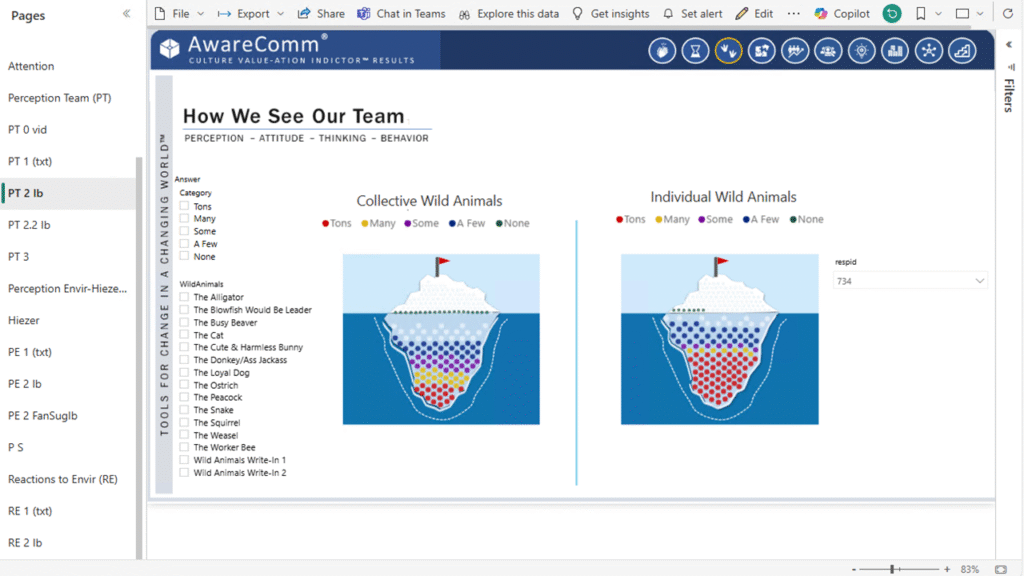
Our comprehensive front-end and benchmark assessment that depict the whole truth including non-respondents, reflecting eMod-ular Adaptive Intelligence (evident above water) and Adaptive Resistance (concealed beneath the surface), as a predecessor to resolution and development.

Tools for Change in a Changing World™
eAdI™ Team Culture
Embedding eMod-ular Adaptive Intelligence™ (eAdI™) as the foundation for workplace transformation ensures that AI, leadership, and human potential align by recognizing and navigating duality.
This shift from Adaptive Resistance™ (AdR™) (presented as the Shadow Culture, disengagement, and addiction) to eAdI™ creates thriving, value-driven, and future-ready environments.
Organization Leaders – Visionaries – Venture Capitalists

Internal and External Strategic Impact
Visionary Co-Lab
Visionary Co-Labs™ embody the Visionary/Leader’s Mission manifested through their team(s).
The Co-Lab™ Institute’s experiential process (Steps 1-6) enables these team(s) to: implement principles to enhance engagement, overcome hidden challenges, deepen market applications with eMod-ular Adaptive Intelligence™, identify audience’s new needs, and expand and diversify revenue, partnerships, and market reach.

The Power of Commerce > Culture > Economy
Community Co-Lab
The modern marketplace is increasingly shaped by AI. Organizations must take the lead in reshaping the marketplace rather than leaving it to AI.
Community Co-Labs™ house a co-operative alliance of Visionary Co-Labs™ who create collective interdependent power for exponential growth, industry influence, and resolution of systemic community challenges (Co-Lab Institute’s™ Consultant-Led Step 7 Business Model – E.A.R. App).
Venture Capitalists

Intentional Strategies for Mission Success
Co-Lab Research and ePublishing Institute
Co-Lab™ Institutes oversee and administer its Consultant-Led 7-Step Business Model Process, including the infusion of proven cause-and-effect principles, to guide their respective Community and Visionary Co-Labs™.

Framework of Transformative Principles and Technologies
AwareComm Ecosystem
AwareComm® and Its Ecosystem evolves the intentional strategies of its mission and Co-Labs™, upholds the whole-istic integrity of the cause-and-effect principles (DRMs™), including the AdR™-eAdI™ AI Copilot, and ignites a depth and breadth of awakening and application.
Replicated Ecosystem Partnerships to uphold ethical principles and ensure that the technology and methodologies will not be misused.
Specialty Partnerships

Restoring Balance and Integrity in Lives
PWI Restorative Recovery Partnerships
The PWI Restorative Recovery Partnerships offers a holistic, educational curriculum-based, and principle-driven approach to long-term recovery, addressing the physical, emotional, financial, relational, and social-impact aspects of individuals and communities.
Grounded in eMod-ular software-courseware™ (eMods™) and eMod-ular Adaptive Intelligence (eAdI™), the program integrates the 5 Dimensions of Restorative Recovery with Transformational Learning, a unique systemic…

Empowering Lives Through Sustainable Discovery
PWI Family Discovery Partnerships
Reaching families where they are.
The Pocket Wisdom Insights (PWI) Library of eMod-ular software-courseware™ (eMods™) is a comprehensive collection of instructional electronic modules designed to explain various Dynamic Relational Models™ and principle-based content through a proprietary delivery process. This innovative approach promotes whole brain integration for optimal learning, providing practical tools for real-life application and …
Organization Leaders – Venture Capitalists

AI’s Mixed Intentions
AI Today
As they comb through massive datasets, AI often blends fear-based content and reasoning that manipulates and trust-based content and reasoning that empowers into the same response, ensuring that the so-called solution can never lead to true resolution. More often than not, the solution itself becomes the next problem.
This presents a hidden danger: AI systems’ mixed intentions is like ink in water…

Distortion in AI Decision-Making
AI Today in HealthCare
The healthcare industry is built upon ethical, patient-centered decision-making, yet AI’s current structure lacks the ability to distinguish between manipulative and empowering logic. If left unchecked, this could lead to:
- Over-reliance on AI recommendations, diminishing human oversight in critical care situations. …
All Decision Makers

Interconnected Concepts for Stability and Strategy
The Rigging
Much like the rigging of a great ship, these interconnected concepts serve as structure, stability, adaptability, and strategy, an interwoven network that holds everything in balance while driving forward momentum.
By uncovering this dynamic interplay, The Rigging offers insight into how each component strengthens the ecosystem, enabling purposeful progress and adaptive solutions for a constantly evolving world, guiding individuals, organizations, and communities toward continuous innovation, resilience, and sustainable growth.

From Vision to Reality: A Journey of Impact
About
As we strengthen our partnership with Microsoft, we enter a pivotal stage in expanding our eMod-ular Adaptive Intelligence™ (eAdI™) framework and scaling our Ecosystem. Leveraging Microsoft Azure’s advanced infrastructure, we’re amplifying the capabilities of our eAdI™ Framework, Ecosystem, No-Code eMod App™ platform, and Adaptive Intelligence solutions. Our goal is to ensure each step forward is practical and impactful.
The introduction of the Culture Value-ation Indicator Private Preview exemplifies this approach, laying the groundwork for future developments like the eAdI™ Copilot. These initiatives underscore our ,,,
Exclusive
AdR-eAdI™ Organizational Culture Value-ation Indicator—Private Preview
We are initiating a Private Preview of our latest innovation, the Organization Culture Value-ation Indicator™ (OCVI™), a comprehensive front-end benchmark assessment.
OCVI™ reveals what others overlook—constructive (eAdI™) and destructive (AdR™) patterns of culture, including Shadow Culture™, disengagement, and addiction. It pairs insight with the proven-over-decades, with our Field Research Partners, eAdI™ Team Culture Program to transform resistance into responsiveness.
Grounded in Möbius loop philosophy, duality, and epigenetic influence and catalyzed by the [AI + BI] plus [HI + SI] = eAdI™ Algorithm, OCVI™ overcomes the flaws of traditional assessments, the silence of non-respondents, and the complexity of AI Agents.
This Private Preview follows the same principle-based process that shaped the success of our ecosystem. Selected organizations will help shape how the OCVI™ reporting is adapted to meet the needs of their industry and receive the broader benefits of a system built for transformation—not just what to change, but how to make it last.